Municipal Service
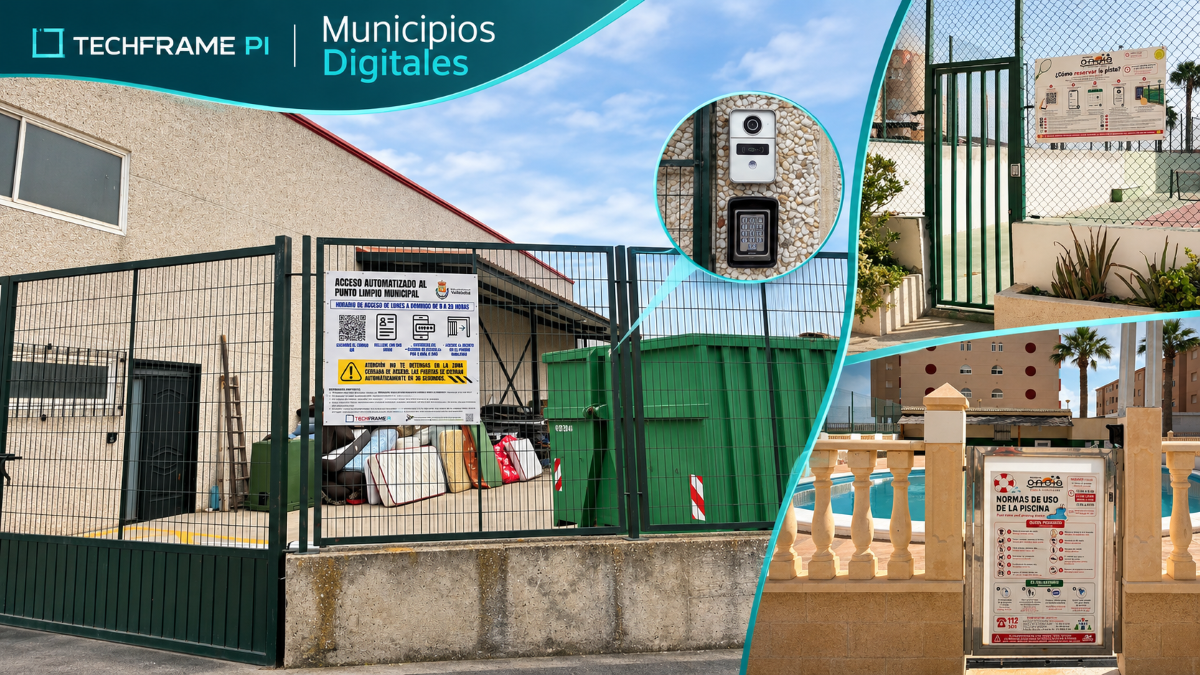
Municipal services that are more accessible and easier to manage
Municipalities manage facilities and services distributed throughout their territory: municipal recycling centres, sports courts, swimming pools, public buildings, storage facilities, access points and spaces that require continuous supervision.
At TechFrame PI, we design complete solutions to connect, automate and manage these spaces, even when they initially have no electricity supply or communications infrastructure.
We transform municipal spaces into connected, accessible and easy-to-manage services.
Better service for residents, greater control for the local authority
Many municipal services still depend on limited opening hours, physical keys, manual checks, staff travel or processes that are difficult to supervise.
We help address situations such as:
- Facilities that can only be used during very limited opening hours.
- Access managed using physical keys or requiring someone to open the facility in person.
- Bookings and requests that require manual intervention.
- Lack of information about who uses a facility and when.
- Spaces without electricity, internet access or permanent staff.
- Incidents that are detected late or require staff to travel to the site to investigate them.
- Disjointed communications between the local authority and users.
The objective is to simplify the resident experience while providing the local authority with information, control and the ability to act in relation to each service.
A solution tailored to each municipal service
We start with the physical space, the service it provides and the local authority's actual needs. From there, we integrate a modular solution that can combine:
- Identification and authorisation: validation of users, documentation, national identity documents or requirements defined by the local authority.
- Bookings and requests: digital forms to request access, book a facility or report an incident.
- Access control: temporary codes, cards, QR codes, smart locks and remote opening.
- Automation: control of doors, lighting, motors, pumps, electrical panels and other equipment.
- Video surveillance: cameras to monitor access points, facilities and critical areas.
- Communications: confirmations and notifications by email, SMS or WhatsApp.
- Autonomous power: solar power and batteries for spaces without a connection to the electricity grid.
- Connectivity: mobile communications and remote access in locations without conventional internet access.
- Management and data: usage records, incidents, reports and supervision by the local authority.
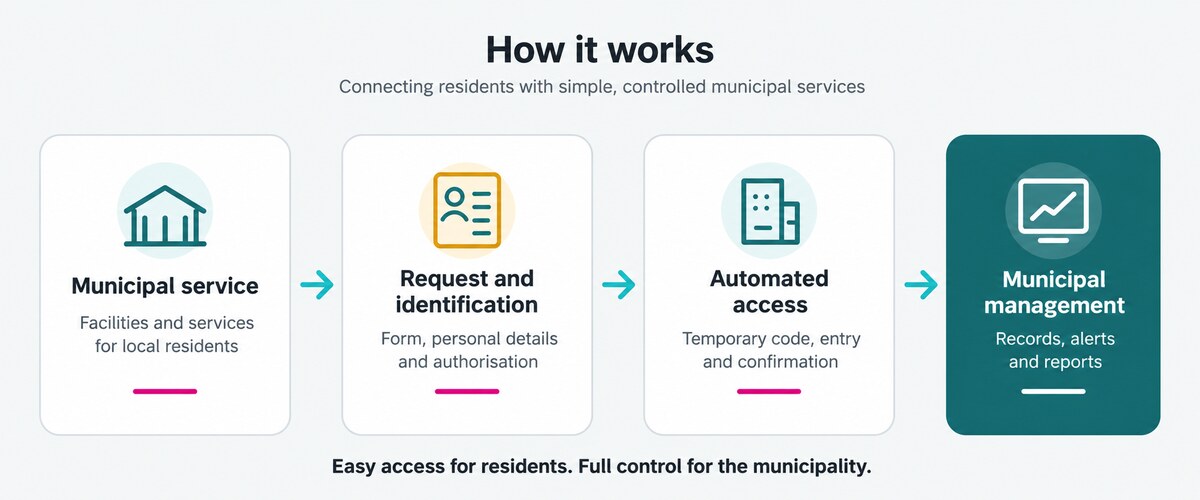
How it works
1. The resident requests or books the service
The user accesses a form through the municipal website, a QR code or another authorised channel to request use of the facility.
2. The system identifies and validates the user
The request can automatically check the requirements defined by the local authority, validate the resident's details and determine whether access is authorised.
3. Access or the service is enabled
The resident receives a confirmation and, when required, a temporary code or authorisation to access the facility on the specified date and at the specified time.
4. The local authority supervises the service and remains in control
Municipal staff can review requests, access records, incidents and device status, obtaining the information they need to manage and improve the service.
Easy access for residents. Full control for the local authority.
Municipal applications
Municipal recycling centres and waste management
We digitalise access to municipal recycling centres using online requests, user validation and temporary codes. Residents can access the facility during authorised hours, while the local authority retains a record of activity.
The solution can incorporate automated gate opening, cameras, user communications, incident records and periodic reports.
Municipal sports facilities
We facilitate the booking of and access to sports courts, swimming pools and other sports facilities using codes, cards or digital credentials, reducing the manual management of keys and extending opportunities for use.
Public buildings and spaces
We connect access points, lighting, energy consumption, alarms and other elements in municipal buildings, storage facilities, community centres and public spaces.
Access control and video surveillance
We integrate gates, locks, readers, cameras and communications to control who accesses a facility, when they do so and what happens on site.
Remote supervision
Municipal staff can check the status of facilities, receive alerts and investigate incidents without the need for repeated journeys to the site.
Communications with residents
We automate confirmations, access instructions, reminders and notifications by email, SMS or WhatsApp, using clear messages tailored to each service.
A real-world example: automated access to a municipal recycling centre
At one municipal recycling centre, access depended on limited opening hours and the availability of staff to open and supervise the facility.
A digital process was designed that allows residents to:
- Scan a QR code or access the municipal form.
- Enter their details and request use of the recycling centre.
- Receive confirmation and access instructions.
- Use a temporary code to open the facility.
The local authority retains a record of requests and access events, can investigate incidents and has the information required to monitor the service.
The solution combines a digital form, user validation, automation, access control, communications, connectivity and remote supervision.
Solutions built around real facilities
Every municipality has different spaces, regulations and procedures. We therefore analyse the existing service, user profiles, opening hours, available infrastructure and the needs of municipal staff before designing the solution.
We can integrate devices that are already installed or progressively add new elements, starting with a specific requirement and subsequently expanding the service.
The same architecture can be used across different municipal spaces, reusing identification, authorisation, communication, access and monitoring processes.
Benefits for the local authority
- Greater availability: the possibility of extending opening hours without proportionally increasing staff presence.
- Less manual administration: automation of requests, validations, access and communications.
- Greater control: records of users, times, opening events and incidents.
- Fewer journeys: remote supervision and operation of facilities.
- Information for improvement: usage data and reports on service operation.
- Modular solution: the possibility of starting with one facility and expanding progressively.
- Reusability: common processes and components for different municipal services.
Benefits for residents
- Easier access to municipal services.
- More flexible opening hours.
- Fewer administrative procedures and unnecessary journeys.
- Clear confirmations and instructions.
- Services available from a mobile phone.
- A faster response to incidents.
The technology remains in the background. Residents simply experience a service that is easy to use and works.
Tell us which municipal service you would like to improve
We can start with a municipal recycling centre, a sports facility, a building or a specific access point and design a solution tailored to the local authority's procedures and resources.